

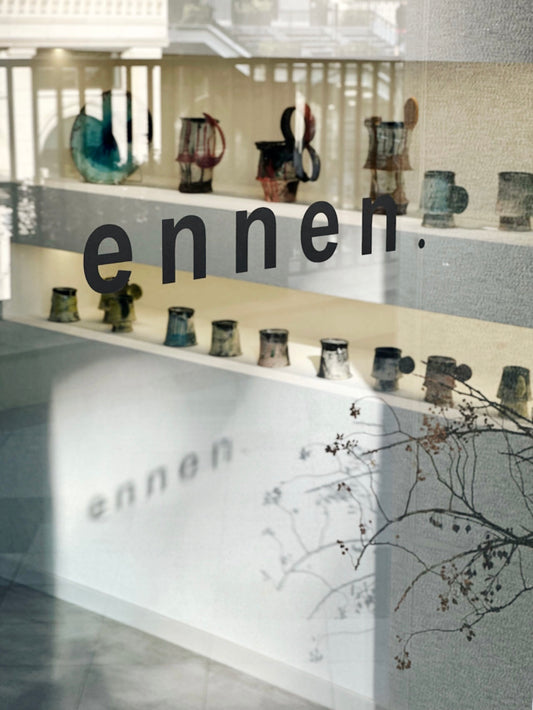


RINTARO NONAKA Solo Exhibition
野中麟太郎展
2025.Dec.13 (sat) – Dec. 21(sun)
Open : 13:00 – 19:00
We are pleased to announce to hold RINTARO NONAKA Solo Exhibition at ennen.
Please look forward to his special exhibition! On the first day of this exhibition, December 13th and 14th, Rintaro Nonaka will be at ennen.
Please take this opportunity to talk to him and we hope you have a wonderful time here!

Inspired by the technique of pâte de verre (※1), Rintaro Nonaka creates his own unique works. He creates molds and pours melting clay and clay ores into them. After that he carves them to complete his pieces. This results in his works with unique textures.
To achieve the texture he desires, he continues to experiment with materials, glazes, new techniques, and unique firing methods, exploring them from various angles. He relies on nature's reactions and enjoys the unexpected results, even though the works that sometimes emerge with a rough texture. The unexpected beauty is the characteristic of his works.
All of his works are not only practical, but also like art pieces with the unique textures. By blending them into our everyday life, the uniqueness of his works is further enhanced, and they are a joy to touch and feel.
This exhibition will feature new works using lacquer and Aji stone(庵治石) (※2) which will be unveiled. By incorporating new materials, his works have a different texture and atmosphere.

 We hope you will enjoy his unique art pieces, which were born from honestly facing his heart and using various clays, glazes, and stones.

※1 Pâte de verre
Pâte de verre is an ancient glass-making technique that originated in ancient Mesopotamia before Christ. It involves putting glass beads into a mold with a paste, firing the mold, and then breaking the mold to remove the glass.
※2 Aji Stone (庵治石)
Aji stone is a high-quality stone found in the towns of Aji of Takamatsu City, Kagawa Prefecture. It is an igneous rock, particularly a type of granite, formed when magma cools and solidifies. Igneous rock is believed to have formed in the late Cretaceous period, approximately 80 million years ago, when magma at temperatures of up to 800 degrees cooled, solidified, and crystallized over a period of tens of thousands to a million years.